
Saturday, May 1, 2010
Brain Labs are Here!
Brain Labs are an innovation of Think Fun, the US educational toy manufacturer. Since I'm teaching at St Josephs School in Nelson this term I thought I'd register the class to take part for a month of thinking skill development. In order to take part in brain labs it is necessary to register an interest first then set up an account for your group. I'll see how it goes this year then spread the word well before next year's event.
 The players are allowed to practice as many times as they like before they enter the tournament. Their results are analysed in conjunction with a US University.

Wednesday, March 31, 2010
Clifton Terrace
Puzzling Nelson is about to start the second of two days with the year 5/6 students from Clifton Terrace School in Nelson. The students applied themselves extremely well on the first day being challenged by a number of crafty puzzles. The students were very perseverant and showed extremely good collaborative skills.
Puzzling Nelson also noticed they spent a fair amount of time playing puzzles on this blog after school which is great to see. Just a word of caution though that excessive amounts of puzzling can make you intelligent.
Puzzling Nelson also noticed they spent a fair amount of time playing puzzles on this blog after school which is great to see. Just a word of caution though that excessive amounts of puzzling can make you intelligent.
Sunday, March 14, 2010
Look what Puzzling Nelson Stumbled Upon
 Trawling through a few class blogs Puzzling Nelson stumbled upon Maths Doodles. An interesting range of maths problems presented in a puzzling style. Puzzling Nelson particularly liked the hydro maze - a game to reinforce quick mental addition and subtraction.
Tuesday, February 16, 2010
Lokulus
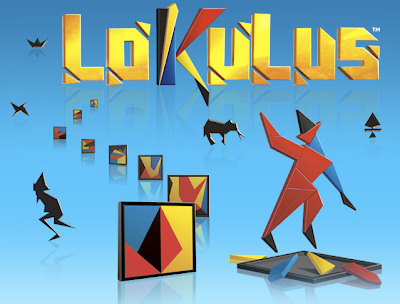
Having just placed an order for a few more puzzles Puzzling Nelson was tempted by a polyform puzzle called Lokulus. Described as the world's oldest puzzle it is similar in many ways to Shape by Shape. After playing on the shop counter at Crackerjack I decided that it deserved a place in my collection.
Monday, February 8, 2010

Friday, February 5, 2010
Clever Castle
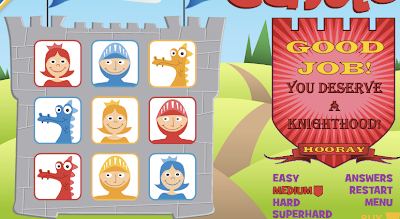
Another game for the younger child is Clever Castle. Choose your difficulty and match the figures on the playing board to the given clues.
Click on the image to play.
Click on the image to play.
Hoppers Jr
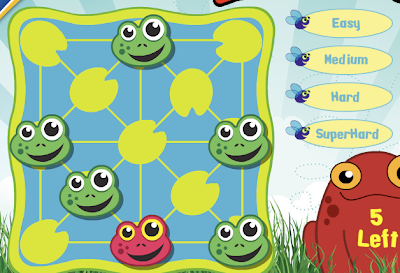
Hoppers Jr is a simplified version of Hoppers designed for younger children. Select your skill level.
Click on the image to play.
Click on the image to play.
What's GNU?
What's GNU is a high paced simple spelling game suitable for junior level children. Keep score, beat your friends.
Click on the image to play.
Click on the image to play.
Tuesday, November 10, 2009

Monday, November 9, 2009
Why Puzzle?
I’ve been puzzling recently over why schools should take time out of their very busy schedule to play puzzles. Well, in terms of its long term value I think it’s time well spent.
What is agreed amongst many educators is that young learners need the ability to understand how to evaluate unfamiliar problems and work through how to solve them. This is the skill of PROBLEM SOLVING.
Problem solving is the cornerstone of school mathematics. Without the ability to solve problems, the usefulness and power of mathematical ideas, knowledge, and skills are severely limited. Students who can efficiently and accurately multiply but who cannot identify situations that call for multiplication are not well prepared.
Students who can both develop and carry out a plan to solve a mathematical problem are exhibiting knowledge that is much deeper and more useful than simply carrying out a computation.
Mechanical puzzles represent the essence of problem solving. When approaching a new puzzle, students can immediately understand what the purpose is, but the techniques that may be required to solve it may be a complete mystery.
Because they are fun as well as challenging, puzzles can teach your children to love and appreciate the problem solving process.
Puzzling Nelson use a range of proven puzzles designed to teach problem solving strategies.
The vast majority of the puzzles are designed by the company ThinFun. It’s interesting to read their philosophy: We believe having fun is great way to learn. That belief is built into every ThinkFun game. ThinkFun games engage kids and educate kids. They challenge players and nurture the thinking skills important to growth and development. Our games aren’t designed to simply occupy a child’s time. They channel the natural joy and energy of play into a stimulating, family-focused way of building essential thinking skills. This philosophy has made ThinkFun a leading provider of children’s games. We’ve won more than 200 awards so far. And we continue to work hard to develop even more games that kids will play to have fun – and to build learning skills.
The feedback from teachers and children has been equally enthusiastic. Children love the tactile nature of the puzzles and the fact that they are levelled for their ability, while teachers see the underlying educational benefits and applications to other curriculum areas and real life problems.
In addition to playing, children are challenged to reflect on their puzzling experience, outlining the object of the game, its rules and restrictions as well as aspects of it that make it difficult. Children are asked to share what strategies they employ to help overcome the problems.
The possibility exists for children to investigate the creation of puzzles. These can be either polyform puzzles, or their own challenge from a favourite game they’ve played. In addition children may seek to apply their game in the real world using PE equipment to simulate the game board and people for the figures. The focus then becomes the language of problem solving - what communication is effective and what is not.
Subscribe to:
Posts (Atom)